From "I Can't" to "I Can't Yet": Building a Growth Mindset Culture with STEM Sprint™ and Agile Kids
Practical ways to build problem-solving skills with Agile methods and STEM Sprint™
What if the single greatest predictor of a child’s success wasn’t their IQ, their resources, or even their school? What if it was simply how they think about their own ability to learn?
After decades of research, psychologist Carol Dweck of Stanford University discovered exactly that. Her groundbreaking book, Mindset: The New Psychology of Success (2006, updated 2016), revealed a simple but profound idea: students who believe intelligence can grow — who have a “growth mindset” — consistently outperform those who believe intelligence is fixed, regardless of their starting ability.
In 2026, as Artificial Intelligence reshapes every industry and the half-life of skills shrinks to under five years, a growth mindset is no longer a “nice to have.” It is the essential survival skill for the next generation.
This article explains what a growth mindset is, why it matters more than ever, and — most importantly — how STEM Sprint™ and Agile Kids methodologies create the perfect environment for K-12 students to develop it.
What Is a Growth Mindset? (The Book & The Author)
Carol Dweck — The Pioneer
Carol S. Dweck, Ph.D. is a professor of psychology at Stanford University and one of the world’s leading researchers in motivation and personality. Her work has been influencing education, sports, and business for over three decades.
The Book: Mindset: The New Psychology of Success
First published in 2006 and updated in 2016, Dweck’s book shows how the mindset we adopt profoundly affects every aspect of our lives — from school to work to relationships.
The core idea is simple:
“In a growth mindset, people believe that their most basic abilities can be developed through dedication and hard work — brains and talent are just the starting point. This view creates a love of learning and a resilience that is essential for great accomplishment.”
— Carol Dweck
In contrast, a fixed mindset is the belief that intelligence and talent are static traits. People with a fixed mindset avoid challenges, ignore feedback, and give up easily because they believe failure reveals their permanent limitations.
Why Is a Growth Mindset Critical for K-12 Students in 2026?
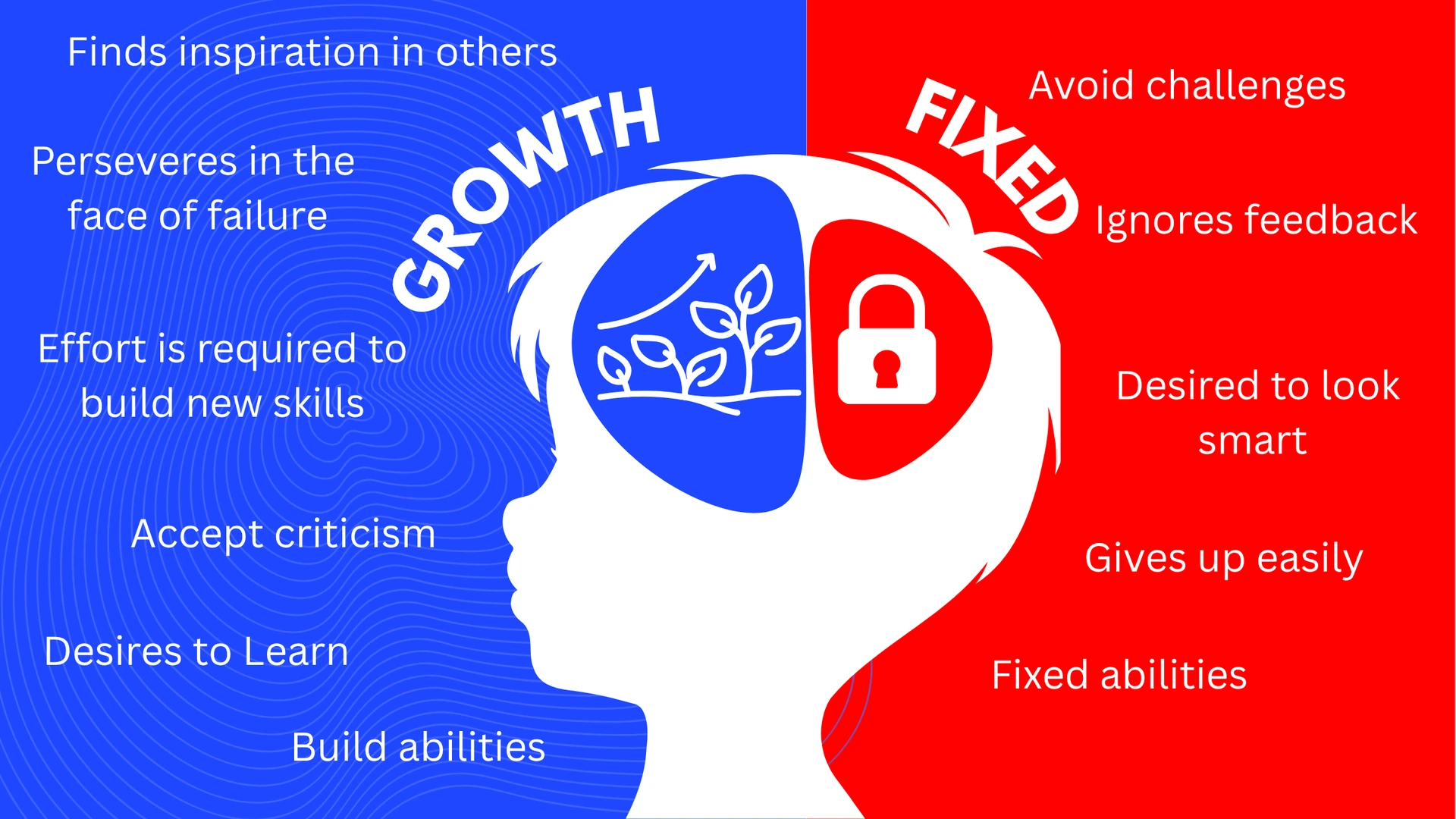
The Two Mindsets Compared
| Fixed Mindset | Growth Mindset |
|---|---|
| Avoids challenges | Finds inspiration in others |
| Ignores feedback | Effort is required to build new skills |
| Threatened by others’ success | Perseveres in the face of failure |
| Desires to look smart | Accepts criticism as a gift |
| Gives up easily | Desires to learn |
| Believes abilities are fixed | Believes abilities can be built |
Why It Matters Now More Than Ever
| Reason | Impact |
|---|---|
| AI is changing work | Students will have multiple careers. Adaptability > initial talent. |
| Mental health crisis | Fixed mindset is linked to anxiety, fear of failure, and avoidance. |
| STEM requires iteration | Science and engineering are built on failure. Without a growth mindset, kids quit. |
| Global competition | In 2026, 75% of STEM graduates are Asian. European students must believe they can grow, not just rely on “smarts.” |
| The “Talent Trap” | Praising kids for being “smart” makes them fragile. They avoid anything hard. |
A quick note on effort: As Dweck herself clarifies, a growth mindset is not just about effort. It’s about having access to support, developing effective strategies, and celebrating improvement, not just trying hard.
How STEM Sprint™ & Agile Kids Naturally Build a Growth Mindset
The Problem with Traditional STEM Education
Most K-12 STEM classes still follow a “right answer” model. Students who struggle feel “bad at science.” Students who succeed feel “good at science.” Neither develops resilience, because both are judged on outcome, not process.
The STEM Sprint™ Solution
STEM Sprint™ (a trademarked methodology blending Agile, Google Design Sprint, Lego Serious Play, Circular Economy, and Reggio Emilia) creates a safe, structured environment for iteration, failure, and improvement.
Here is how each Agile principle directly builds growth mindset:
| STEM Sprint™ and Agile Principle | Growth Mindset Trait Developed |
|---|---|
| Short iterations (Sprints) | Perseverance — failure is just a “redo,” not a final judgment. |
| Retrospectives | Accepts criticism — feedback becomes data, not personal attack. |
| Visible progress | Desires to learn — the goal is improvement, not perfection. |
| Collaboration over individual genius | Finds inspiration in others — others’ success becomes a learning source, not a threat. |
| “Fail fast, learn faster” | Perseveres in the face of failure — failure is a required step, not an ending. |
| Student ownership | Effort is required — they see direct connection between work and progress. |
| Biomaterials & local resources | Builds abilities — mastery comes from doing, not from having expensive tools. |
From Theory to Practice: A Classroom Example
Scenario: A 7th grade team in Valencia is designing a water filter using recycled plastic bottles and cornstarch bioplastic.
| Fixed Mindset Reaction | Growth Mindset Reaction (With STEM Sprint™) |
|---|---|
| “This is too hard. I’m not an engineer.” | “We don’t know how yet. Let’s research and try prototype #1.” |
| “Why did theirs work and ours failed?” | “What can we learn from their design? Let’s ask them.” |
| “I give up.” | “Our filter leaked. For Sprint #2, we’ll add a second layer of bioplastic.” |
| “Just tell us the answer.” | “We have 30 minutes. Let’s run a mini-retrospective and decide our next iteration.” |
The Agile structure normalizes failure as a data point, not a verdict. Over time, students internalize that ability is built, not born.
How to Start Using Growth Mindset — 5 Practical Steps for Teachers & Parents
You do not need to change your entire curriculum overnight. Start with these five small shifts:
Step 1: Change Your Praise
| Instead of… | Say this… |
|---|---|
| “You’re so smart!” | “I love how you kept trying different strategies.” |
| “You got an A!” | “I can see how much effort you put into improving.” |
| “You’re a natural at math.” | “Your persistence with that problem really paid off.” |
Why it works: It shifts focus from fixed traits to process and improvement.
Step 2: Add the Word “Yet”
When a student says “I can’t do this,” add “…yet.”
“I don’t understand fractions… yet.”
“I’m not good at coding… yet.”
Why it works: “Yet” transforms a permanent failure into a temporary state.
Step 3: Normalize “Failures” as Data
After any project, ask three questions:
What worked well?
What didn’t work? (No blame — just facts)
What will we try differently next time?
Why it works: It builds the retrospective habit from Agile, removing shame from failure.
Step 4: Model Your Own Growth Mindset
Let students hear you struggle and learn:
“I don’t know how to fix this 3D printer… yet. Let’s read the manual together.”
“I was frustrated with that lesson too. Here’s what I learned from it.”
Why it works: Kids learn more from what you do than what you say.
Step 5: Introduce a Growth Mindset “Hero” (Real or Class-Created)
Share stories of famous failures turned successes:
Thomas Edison: “I have not failed 10,000 times. I have successfully found 10,000 ways that will not work.”
Michele Obama: She had to overcome people telling her she was “not smart enough” for Princeton.
Your own story: Tell them about a time you failed and learned.
Why it works: Stories are sticky. They create emotional anchors for the abstract concept of “growth.”
The Science Behind Growth Mindset (For Curious Adults)
| Concept | Evidence |
|---|---|
| Neuroplasticity | The brain physically changes when we learn. Intelligence is not fixed; it grows with effort. |
| Dweck’s 1998 study | 7th graders taught a growth mindset reversed a decline in math grades, while fixed mindset peers continued to fall. |
| Brain scans (2015) | Students with growth mindset show greater brain activity when making mistakes — they process errors, not avoid them. |
| Impact in STEM | A 2022 meta-analysis found growth mindset interventions boost science and math performance, especially for struggling students. |
Bottom line: This is not “positive thinking.” This is cognitive science.
Your Next Step — Bring STEM Sprint™ to Your School
You have read the theory. You have seen the practices. Now, see the methodology in action that makes growth mindset automatic, not aspirational.
STEM Sprint™ is the only K-12 framework that weaves Agile, Design Sprint, and Circular Economy into a trademarked, repeatable system for building resilience, creativity, and problem-solving.
What You Get With a STEM Sprint™ Demo (20-min, no cost)
A live walkthrough of how Sprints work without exposing proprietary details
Real examples of growth mindset outcomes from pilot schools
A clear, zero-cost path to implementing STEM Sprint™ in your classroom or district
“Our students used to say ‘I’m not a science person.’ After two Sprints, they argue over who gets to test the next prototype. The mindset shift was visible in weeks.”
— 5th grade teacher, Valencia pilot
Ready to transform how your students see themselves?
👉 Contact us today for your free 20-minute demo.
Visit: www.stemh.org/contact-us
No cost. No commitment. Just a conversation about building the resilient, curious, capable generation Europe needs.
About the Author STEM+H
*This article was prepared by a STEM education researcher and curriculum curator specialising in the intersection of cognitive science, technology integration, and K-12 pedagogy.*
Resources & Data Sources
| Source | Key Insight |
|---|---|
| Dweck, C. (2006, 2016). Mindset: The New Psychology of Success. | Origin of fixed vs. growth mindset theory. |
| Sources of Insight (2023) | Practical 10-step guide to cultivating growth mindset. |
| Getting Results (Agile) | Agile principles for personal and team growth. |
| Big Life Journal | Growth mindset activities for K-8 kids. |